Sine and cosine on the unit circle
Transcript
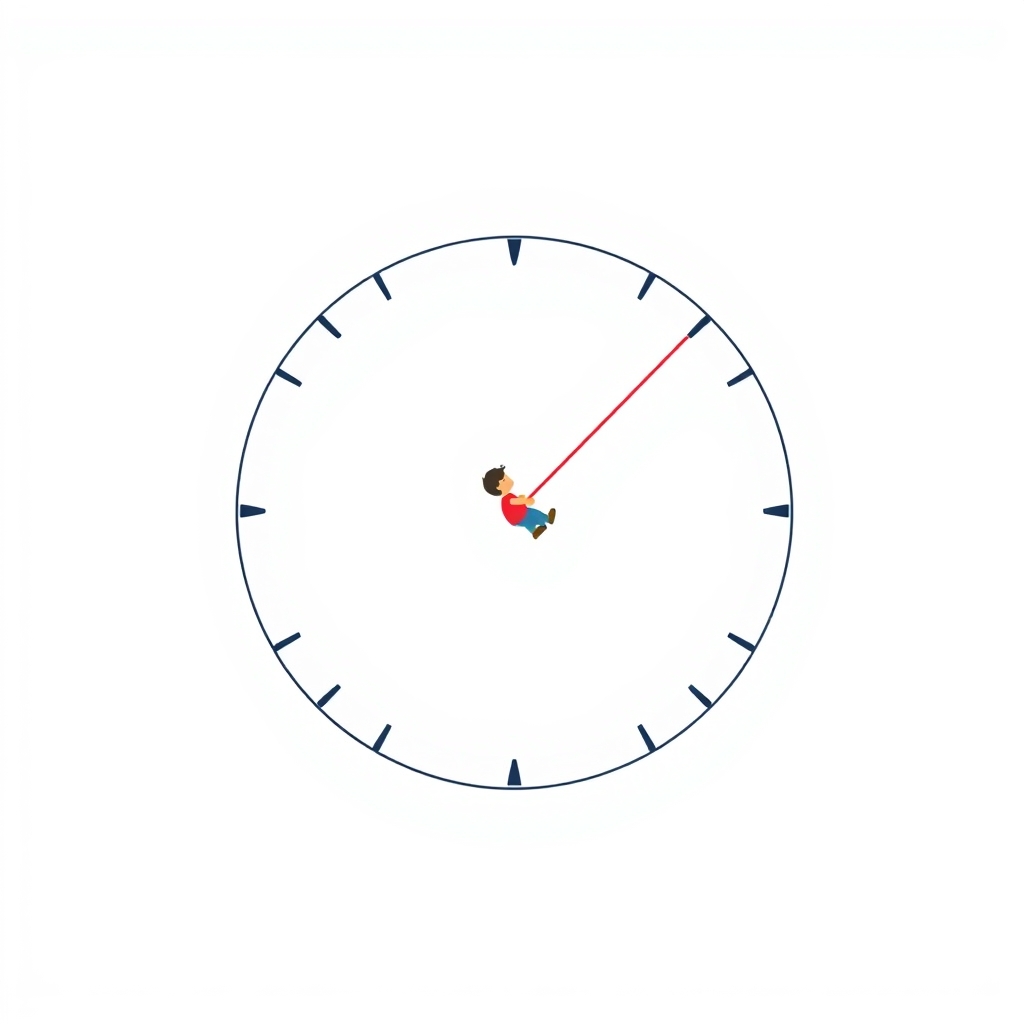
Imagine a circle with radius one, and a spinning arm inside it.
The unit circle is a circle with radius exactly one, centered at the origin. When the arm rotates to an angle, it touches the circle at a point. The x-coordinate of that point is the cosine of the angle.
- Radius = 1
- Angle = 45 degrees
The y-coordinate of that point is the sine of the angle. At zero degrees, the arm points right: cosine is one, sine is zero.
\cos(0°) = 1, \sin(0°) = 0At ninety degrees, the arm points up: cosine is zero, sine is one.
\cos(90°) = 0, \sin(90°) = 1At forty-five degrees, both are equal: about zero point seven.
\cos(45°) = \sin(45°) \approx 0.707At one hundred eighty degrees, the arm points left: cosine is minus one.
\cos(180°) = -1, \sin(180°) = 0Here's the key: sine and cosine are just the coordinates of a point on the unit circle.
Quick quiz: at sixty degrees, which is bigger, sine or cosine? Sine and cosine are the secret bridge between angles and coordinates.
- sin = y-coordinate, cos = x-coordinate
Quick quiz
Q1. At 60 degrees on the unit circle, is sine or cosine larger?
At 60°, the point is higher than it is wide, so sine is larger.