Pythagoras' Theorem
a^2 + b^2 = c^2Transcript
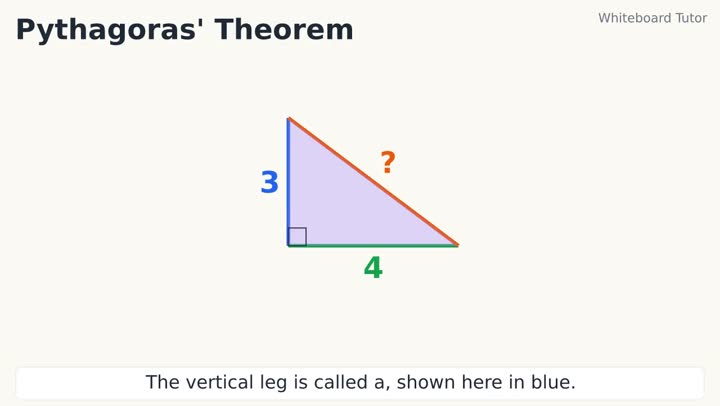
Pythagoras' theorem links the three sides of any right triangle together. In a right triangle, the longest side is called the hypotenuse. The two shorter sides are the legs, which we call a and b.
Here's the magic: a squared plus b squared equals c squared.
a^2 + b^2 = c^2Let's try a real example: legs are three and four units long. Three squared is nine, four squared is sixteen. Nine plus sixteen equals twenty-five.
- 3² = 9
- 4² = 16
- 9 + 16 = 25
So c squared is twenty-five, meaning c equals five. We can visualize this by drawing squares on each side. The two smaller squares together equal the big square on the hypotenuse.
- c² = 25, so c = 5
This works for any right triangle, not just three-four-five. Quick check: if legs are five and twelve, what is the hypotenuse? Pythagoras' theorem is the foundation for distance, trigonometry, and 3D geometry.
- Works for all right triangles
- Key tool in math and physics
Quick quiz
Q1. Legs are 5 and 12. Find the hypotenuse.
5² + 12² = 25 + 144 = 169 = 13²