Euler's Number e
Transcript
Four numbers, e, i, pi, one and zero, tie together in one equation, and Euler's number e is the doorway. Start with money. Put one pound in a bank paying one hundred percent interest per year, and watch compounding. Compounding once a year gives two pounds. Compounding n times a year gives one plus one over n, all raised to the power n.
A_n = \left(1+\frac{1}{n}\right)^{n}Try small cases. With n equal two, we get one point five squared, which is exactly two point two five.
A_2 = 1.5^2 = 2.25With n equal to twelve, monthly compounding, the value is about two point six one three. It creeps upward.
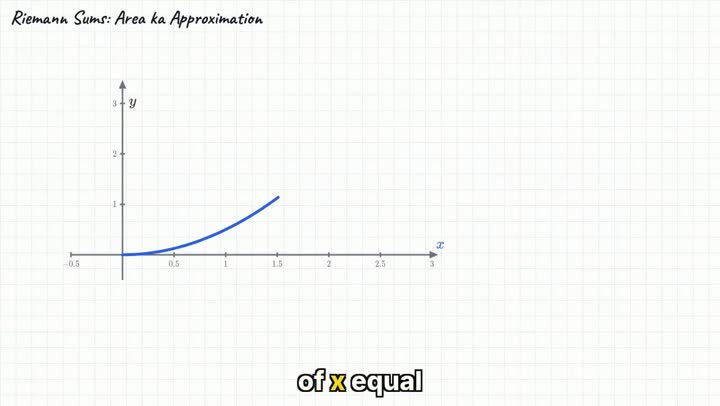
A_{12} \approx 2.613Does it grow forever? No. Watch the graph of x plus one over x, rising but flattening. The sequence increases and is bounded above, so by the monotone convergence theorem, a limit exists. We name it e.
e = \lim_{n\to\infty}\left(1+\frac{1}{n}\right)^{n} \approx 2.71828Bounded is the key claim. Expand with the binomial theorem and compare each term with one over k factorial.
\left(1+\frac{1}{n}\right)^{n}=\sum_{k=0}^{n}\binom{n}{k}\frac{1}{n^k}Each binomial term simplifies. Choose n, k over n to the k equals one over k factorial times a product of factors below one.
\binom{n}{k}\frac{1}{n^k}=\frac{1}{k!}\prod_{j=0}^{k-1}\left(1-\frac{j}{n}\right)As n grows, every product tends to one, and the terms increase toward one over k factorial. So e is the sum of all of them.
e=\sum_{k=0}^{\infty}\frac{1}{k!}=1+1+\frac12+\frac16+\dotsCheck numerically. One plus one plus a half plus a sixth plus a twenty-fourth already gives about two point seven oh eight.
1+1+0.5+0.1\overline{6}+0.041\overline{6}\approx 2.708Now the real reason e matters. Look at the curve y equals e to the x, and its slope. The defining property: the derivative of e to the x is e to the x. Slope equals height, everywhere.
\frac{d}{dx}e^{x}=e^{x}Why? Differentiate a to the x from the definition. The slope at zero is the limit of a to the h minus one, over h.
\frac{d}{dx}a^{x}=a^{x}\lim_{h\to0}\frac{a^{h}-1}{h}That limit is a constant depending on a. The number e is exactly the base that makes the constant equal one.
\lim_{h\to0}\frac{e^{h}-1}{h}=1So e is the natural base. Any exponential a to the x equals e to the x times natural log of a.
a^{x}=e^{x\ln a}Link to the bigger idea: the series for e to the x. Replace x with i times theta, and watch the unit circle appear. Euler's formula says e to the i theta equals cosine theta plus i sine theta. Multiplying by it rotates, never stretches.
e^{i\theta}=\cos\theta+i\sin\thetaTurn the angle to one hundred eighty degrees. The point lands on minus one, giving Euler's identity.
e^{i\pi}+1=0A common misconception: e is not just a rounded decimal like pi, and it is not rational. Euler himself showed it is irrational. An edge case: compounding more often never beats continuous growth. Continuous compounding at rate r gives A equals P e to the r t.
- e is irrational, never repeats
A=Pe^{rt}Real life: with continuous growth, doubling time is natural log of two divided by r, about zero point six nine three over r.
Quiz time. Which statement explains why e is called the natural base for calculus? Summary: e is the limit of compounding, the sum of one over k factorial, and the base whose slope equals itself.
e=\lim_{n\to\infty}\left(1+\tfrac1n\right)^n=\sum_{k\ge0}\tfrac1{k!}Quick quiz
Q1. Why is e the natural base for exponentials in calculus?
Misconception: e is not special for size or irrationality; its derivative property is what matters.