Rotation: ek deep dive
Transcript
Ek point ghoomta hai, par ek line apni jagah rehti hai. Kaise?

Rotation matlab ek fixed point ke around ghoomna. Yahi point centre of rotation kehlata hai.
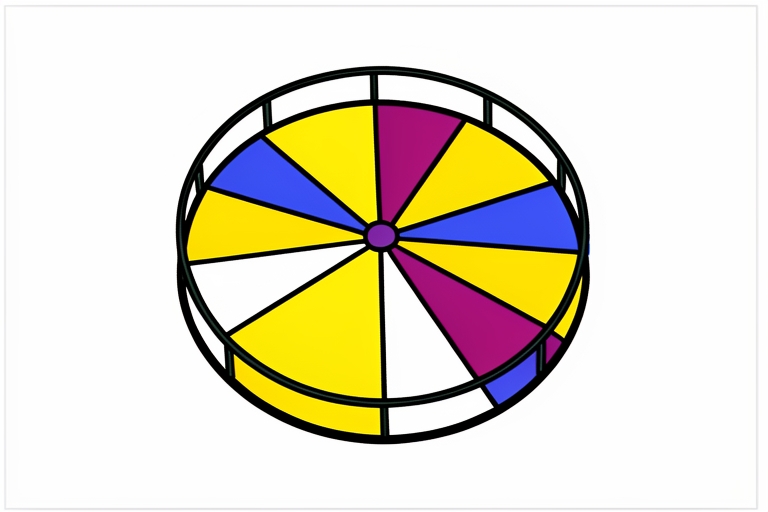


Rotation ke teen cheezein hote hain: centre, angle, aur direction. Counterclockwise ko positive maante hain. Ab sabse important baat: rotation mein origin se distance kabhi nahi badalta. Point ek circle par chalta hai. Ab derivation. Point P ke coordinates hain x aur y. Isse polar form mein likhte hain, radius r aur angle alpha.
- Counterclockwise = positive angle
x = r\cos\alpha,\quad y = r\sin\alphaTheta se rotate karne par naya angle alpha plus theta ho jaata hai, aur r same rehta hai.
x' = r\cos(\alpha+\theta),\quad y' = r\sin(\alpha+\theta)Ab angle addition formula lagao. Cos of alpha plus theta ko expand karo.
x' = r\cos\alpha\cos\theta - r\sin\alpha\sin\thetay' = r\sin\alpha\cos\theta + r\cos\alpha\sin\thetaR cos alpha ki jagah x, aur r sin alpha ki jagah y daalo. Rotation matrix mil gaya.
\begin{pmatrix}x'\\y'\end{pmatrix}=\begin{pmatrix}\cos\theta & -\sin\theta\\ \sin\theta & \cos\theta\end{pmatrix}\begin{pmatrix}x\\y\end{pmatrix}Ek concrete example lo. Point (3, 4) ko 90 degree counterclockwise rotate karo. Yahan cos 90 zero aur sin 90 ek hai.
(3,4)\rightarrow(-4,\,3)Check karo: pehle distance root of 3 squared plus 4 squared, yaani 5. Baad mein bhi 5. Distance preserve hua.
Matrix ka determinant ek hota hai, aur transpose uska inverse hai. Isse orthogonal matrix kehte hain, jo shape aur size preserve karta hai. Common misconception: log sochte hain ki rotation hamesha origin ke around hota hai. Galat! Kisi bhi point ke around ho sakta hai. Is process ka general formula: pehle translate karo minus C, phir rotate karo, phir translate karo plus C.
- Pehle C ko origin banao, rotate karo, wapas shift karo
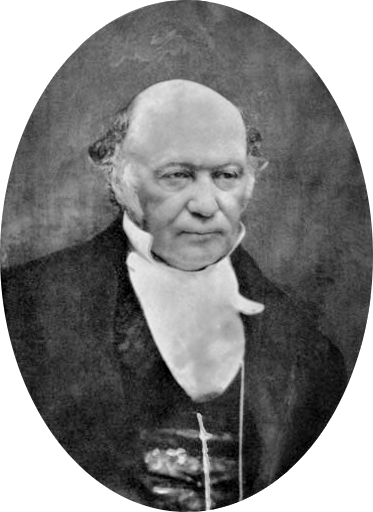
P' = R(\theta)(P - C) + CAur bade idea se link: 3D mein rotations commute nahi karte, isliye order matter karta hai. Quaternions Hamilton ne 1843 mein banaye, jo robotics aur graphics mein use hote hain.


Ab ek sawaal. Agar tum point ko pehle 30 degree, phir 60 degree rotate karo, to total kya hoga? Summary: rotation ek orthogonal transformation hai jo distance aur orientation preserve karti hai, aur uska matrix cos aur sin se bana hota hai.
- Rotation = distance preserve, angle add
Quick quiz
Q1. 2D mein 30 degree ke baad 60 degree rotate karne par final result kya hoga?
Misconception: angles multiply ya overwrite hote hain; actually 2D rotation matrices multiply hote hain aur angles add ho jaate hain.