The Chain Rule: Deep Dive
Transcript
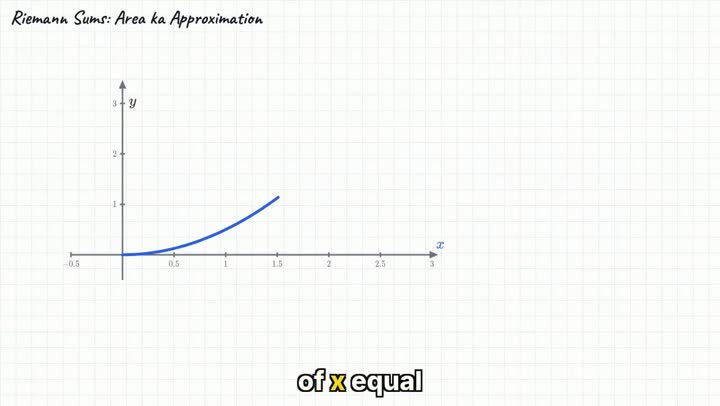
Socho ek function ke andar doosra function chhupa ho: aise composite function ki rate of change kaise nikalte hain? Wahi hai chain rule. Pehle ek concrete example lete hain: h of x equals sin of x squared. Yahan inner function x squared hai aur outer function sine hai.
h(x)=\sin\left(x^2\right)Graph dekho: x squared se pehle y banta hai, phir sine uska output leta hai. Neeche ek point pe slope dekhenge. Ab notation define karte hain. Let y equal g of x, aur z equal f of y. Tab z ek composition hai, f of g of x.
{\color{blue}{y=g(x)}},\quad {\color{orange}{z=f(y)}},\quad z=f(g(x))Chain rule kehta hai: derivative of z with respect to x equals dz by dy times dy by dx. Do rates ka product.
\frac{dz}{dx}={\color{orange}{\frac{dz}{dy}}}\cdot{\color{blue}{\frac{dy}{dx}}}Lagrange notation mein ye hota hai: h prime of x equals f prime of g of x, times g prime of x.
h'(x)={\color{orange}{f'(g(x))}}\cdot{\color{blue}{g'(x)}}Ek bahut important baat: f prime ko inner function g of x pe evaluate karte hain, x pe nahi. Yahi sabse common slip hai. Ab derive karte hain. Jab x thoda sa change hota hai by delta x, to y change hota hai by delta y, jo g ke change se aata hai.
\Delta y=g(x+\Delta x)-g(x)Phir z bhi change hota hai. Agar delta y nonzero ho, to delta z by delta x ko do fractions ke product mein tod sakte hain.
\frac{\Delta z}{\Delta x}=\frac{\Delta z}{\Delta y}\cdot\frac{\Delta y}{\Delta x}Ab limit lo jahan delta x zero ki taraf jaata hai. Kyunki g differentiable hai, g continuous hai, isliye delta y bhi zero ki taraf jaata hai.
\lim_{\Delta x\to 0}\frac{\Delta z}{\Delta x}=\lim_{\Delta y\to 0}\frac{\Delta z}{\Delta y}\cdot\lim_{\Delta x\to 0}\frac{\Delta y}{\Delta x}Limits ka product ban gaya: dz by dy times dy by dx. Ye hai chain rule ka core idea. Edge case: agar delta y zero ho jaye, to division allowed nahi. Rigorous proof isko alag tareeke se handle karta hai, lekin result wahi rehta hai. Ab example solve karte hain. Inner function g of x equals x squared, to g prime of x equals two x.
- delta y = 0 ho sakta hai: proof alag
{\color{blue}{g(x)=x^2}}\ \Rightarrow\ {\color{blue}{g'(x)=2x}}Outer function f of y equals sine of y, to f prime of y equals cosine of y.
{\color{orange}{f(y)=\sin y}}\ \Rightarrow\ {\color{orange}{f'(y)=\cos y}}Ab combine karo: cosine of x squared times two x. Notice karo, cosine ke andar x squared hi rehta hai.
h'(x)=\cos\left(x^2\right)\cdot 2xAb x equals one pe slope nikalte hain. Yahan x squared one hota hai, aur two x equals two.
h'(1)=\cos(1)\cdot 2Decimal mein, cosine of one approximately point five four zero hai, to h prime of one approximately one point zero eight zero. Radians mode zaroori hai.
h'(1)\approx 0.540\cdot 2\approx 1.081Ek misconception: log yahan ek galti hoti hai, derivative of sin of x squared ko cos of x squared likh dena aur two x bhool jana. Ye inner derivative miss karna hai.
\frac{d}{dx}\sin\left(x^2\right)\neq\cos\left(x^2\right)Ek aur example se feel lo: sine of three x ka derivative three cosine of three x hai. Inner ki slope bahar aati hai.
\frac{d}{dx}\sin(3x)=3\cos(3x)Bigger picture: integration mein iska counterpart substitution rule hai, jise u-substitution bhi kehte hain. Chain rule ko ulta padho, to wahi milta hai.
AP Exam tip: free response mein setup likho, jaise inner aur outer function aur chain rule ka naam. Sirf final number se points ja sakte hain. Ab ek AP-style question. Kaun sa option sahi hai? Summary: derivative of a composition equals outer derivative at the inner function, times the inner derivative. Hamesha inner derivative multiply karna mat bhoolo.
- Exam tip: setup zaroor likho
Quick quiz
Q1. If h(x) = (x^3 + 1)^4, which expression is h'(x)?
Option A inner derivative 3x^2 bhool jaata hai, jo classic chain rule misconception hai.