A Short Stay in Hell
Transcript
What if Hell were a library you could never finish searching?

Steven Peck's 2009 novella follows Soren Johanssen, a condemned soul who wakes in an endless library, orders of magnitude larger than the known universe.
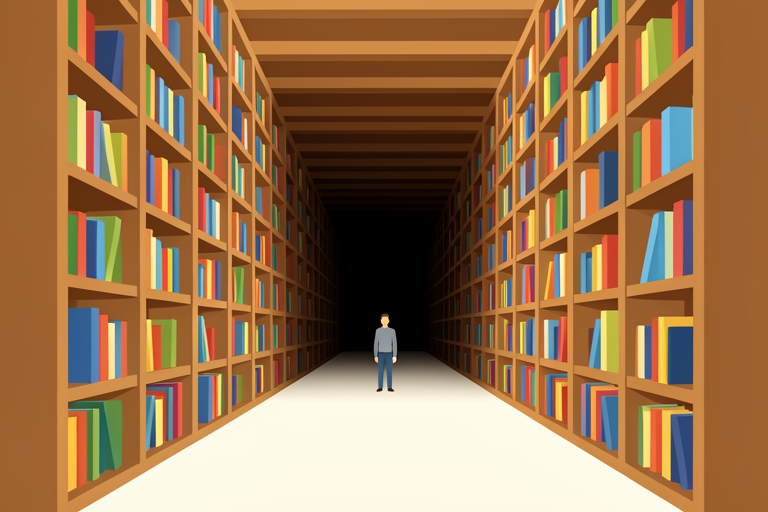

His task sounds simple: find the one book that perfectly describes his earthly life, every moment, no errors. Then he is released.
The premise is adapted from Jorge Luis Borges, whose 1941 story, The Library of Babel, imagined a library holding every possible book.
- Borges: Library of Babel, 1941

Here is the mechanism. If books are made by every possible arrangement of characters, the number of books is the alphabet size raised to the book length.
- k symbols, L characters per book
N = k^{L}Borges used about twenty-five symbols and four hundred ten pages. Even a modest book length makes N unimaginably huge, though still finite. Now the key insight: nearly all those books are gibberish. Meaningful text is a vanishingly thin sliver of the whole.
- Adding length multiplies, not adds
Worse for Soren: the library also holds countless near-copies of his biography, each wrong in one tiny detail. Telling them apart is the trap. Compare scales honestly. The observable universe has roughly ten to the eighty atoms, and the library dwarfs even that, by design. A common misconception: infinite means unreachable, but this library is finite. Finite yet beyond comprehension is the horror, because the mind cannot process such numbers.
- Illustrative: library is far bigger
Peck's story then probes eternity. With unlimited time, Soren evolves methods, rituals and sanity-saving systems, yet still faces effectively endless search.
Edge case: even a perfect match would not help, because Soren could never verify it against his entire life, except by checking every word.


The bigger link: this echoes the infinite monkey theorem, where randomness only produces meaning at astronomically improbable odds.
So the real theme is absurdity: meaning needs selection, and a library of everything contains no help finding anything. Quiz time: why is Soren's task nearly hopeless even though the library is finite? In short: A Short Stay in Hell turns Borges's finite-but-unimaginable library into a vivid punishment, showing how huge numbers defeat the human mind.
- Everything stored = nothing findable
Quick quiz
Q1. Why is Soren's search effectively hopeless despite a finite library?
Finite does not mean searchable; confusing finite with feasible is the misconception.