How sunlight works
Transcript
Every photon on your skin began as a fusion reaction.
Deep in the Sun's core, hydrogen nuclei fuse into helium, releasing energy as gamma rays, at around fifteen million degrees.
Mass is converted to energy through E equals m c squared, so a tiny mass loss powers the whole star.
- Fusion turns mass into light
E = mc^2But those photons do not escape quickly. Each one bounces off charged particles, a random walk lasting between ten thousand and a hundred seventy thousand years.
Once free at the surface, light crosses space in a straight line, taking about eight point three minutes to reach Earth. A common misconception: the light you see tonight is not old by thousands of years. The slow part was inside the Sun, not in space.
The Sun's surface acts almost like a blackbody at about fifty-eight hundred kelvin, so its light spans a broad spectrum of wavelengths.
T \approx 5800\ \text{K}Wien's law says peak wavelength falls as temperature rises, so the Sun peaks in the visible green region, which is why our eyes evolved there.
- Hotter = shorter wavelength
\lambda_{\text{peak}} = \frac{b}{T}Sunlight splits into ultraviolet, visible and infrared. Visible light and infrared carry most of the energy, while ultraviolet is a small share.
Entering the atmosphere, light is scattered and filtered. Ozone absorbs most harmful ultraviolet before it reaches the ground.
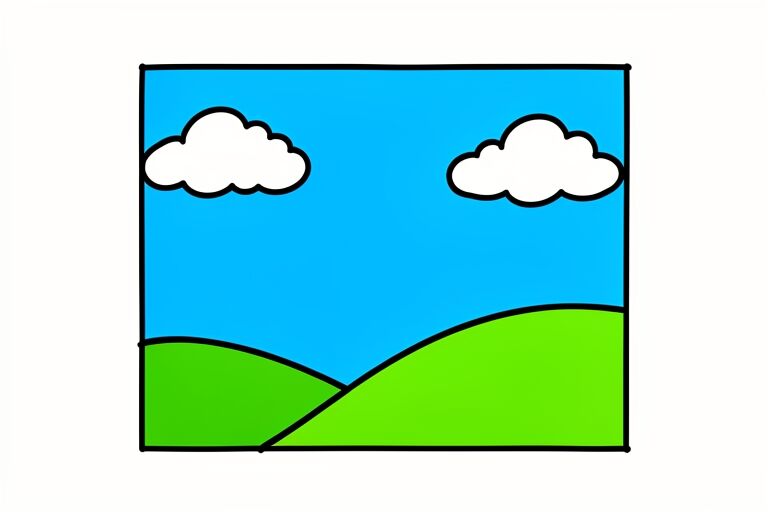
Short blue wavelengths scatter far more than red ones, called Rayleigh scattering, with strength proportional to one over wavelength to the fourth.
I_{\text{scatter}} \propto \frac{1}{\lambda^4}So blue light bounces all over the sky, and that is why the daytime sky looks blue.
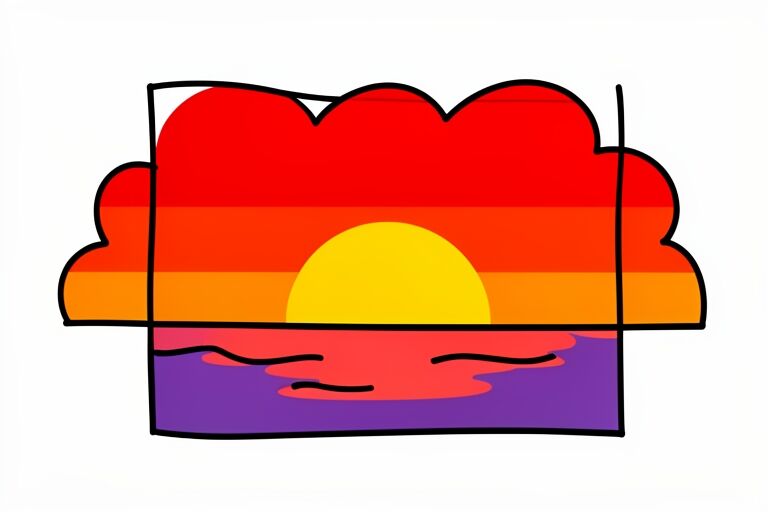
At sunset, light crosses far more air, scattering blue away and leaving reds and oranges. Also, the sky is not violet because our eyes are less sensitive to it. Sunlight energy is huge: about a quarter of the solar irradiance at the top, between one sixty-four and three forty watts per square metre, averaged over Earth. That is because Earth is a sphere: the disc facing the Sun intercepts light spread over the whole surface, a factor of four.
Plants, clouds and oceans all use or reflect this energy, driving photosynthesis, weather, and the water cycle that sustains life. Quick check: why does the sky look red at sunset rather than blue? In summary: fusion makes light, it escapes slowly, crosses space in eight minutes, and the atmosphere shapes it into our blue sky and warm sunsets.
Quick quiz
Q1. Why is the sunset sky red instead of blue?
The Sun never changes colour; a longer air path scatters blue sideways, leaving red.